
How to weaponise a dinner table: Reflecting on two masterful scenes in Whiplash and American History X.

Updated: Apr 7

Two iconic dinner scenes reveal how family rituals can quietly shape identity, belonging, and harm — especially through a neurodivergent lens.
As my friend and I are in the exciting early stages of developing our new podcast, The Neurodivergent AF Film Club, I’ve been reflecting on some of my favourite movies. Which feels like the perfect excuse to dive into two unforgettable dinner-table scenes from American cinema — Whiplash (2014) and American History X (1998). Heads up: I’m firmly in special-interest territory here, so thanks for coming along for the ride.
The good ol' family dinner. You know, those happy, communal gatherings that, in film, often symbolise warmth, connection, and safety. Hands passing the salt and pepper shakers, platters of colourful food laid out like culinary centrepieces, the clink of cutlery and pouring of wine.
And yet, some of the most unsettling moments in cinematic history take place right here. It’s a masterstroke of juxtaposition when directors use familiar sounds and imagery to subvert a comfortable scenario into the nightmarish territory of uncanny valley.
Two brilliant examples are the scenes in Whiplash and American History X. On the surface, they couldn’t be more different. One is quiet, awkward, and middle-class. The other is loud, confrontational, and overtly political.
But take a deeper look and they’re doing strikingly similar work — especially when viewed through a neurodivergent lens.
A social minefield
For many neurodivergent people, the family dinner table is not a neutral space. It’s a stressful and complex performance arena. A gladiator arena without any armour.
There are unwritten rules — when to speak and when not to; don’t be too quiet or too enthusiastic; and know which opinions are safe and which are taboo.
As a polite guest, you’re expected to read the room while also being in the room. To modulate tone. To know when passion becomes overly intense. To make yourself legible to people who may not share your values, interests, or communication style.
Both Whiplash and American History X understand this instinctively. They show how identity, ideology, and ambition are shaped not just by what is said, but by how a room responds.
Whiplash
One reason this scene lands so forcefully is that the dialogue sounds almost reasonable — until it suddenly isn’t.
Andrew Nieman, the protagonist played brilliantly by Miles Teller, has a defining line late in the exchange, once the bomb after bomb of casual minimisation finally becomes too much for him to bear:
‘‘I’d rather die drunk, broke at thirty-four and have people at a dinner party talk about me than live to be rich and sober at ninety and nobody remembered who I was.’’
It’s an extreme statement, and the family reacts as if Andrew has proven their point. But from a neurodivergent perspective, it reads less like grandiosity and more like a failure of translation.
In this moment, Andrew is battling to contain his temper as he tries, unsuccessfully, to explain his drive, legacy, and meaning in a room that only recognises socially legible success.
Later, a middle-aged woman at the table (Aunt Emma) attempts to diffuse the escalating tension by redirecting with banal, domestic cheer — "Who wants dessert?"
It’s a small, ineffective gesture, but a loaded one.

For a lot of neurodivergent people, this kind of interruption may look deeply familiar. Conflict isn’t resolved; it’s covered. Emotional intensity is treated as a social problem to be managed, not a signal to be understood.
Andrew’s words hang in the air for barely a second before being countered by his father, who not only disagrees with this sentiment but is clearly disturbed by his son’s point of view.
In Whiplash, the family dinner scene is excruciating precisely because no one appears overtly cruel.
No one shouts. No one insults him outright. Everyone believes they’re being reasonable.
Andrew is attempting to articulate why music matters to him — why his single-minded pursuit of drumming is worth sacrifice, obsession, even suffering. But his intensity and achievements are met with jokes and gentle dismissal. The conversation quickly shifts back to his athletic cousins, whose accomplishments fit more comfortably within the family’s idea of success. It’s a familiar neurodivergent experience: when what lights you up is treated as a curiosity rather than something worthy of equal attention.
The family is in the midst of praising Travis (the older cousin) for being named season MVP. Everyone is clearly impressed and enthusiastic; a stark contract to the brief, condescending discussion of Andrew's milestones.
"It's division three," Andrew mutters. Everyone looks at him; you could cut the tension with a knife. You can almost imagine him thinking, Well, there's no turning back now. "He plays for Carleton. It's division three. It's not even division two. It's division three."
These words provoke Uncle Frank to grill Andrew about whether he has any friends, leading to Andrew's famous rant (quoted earlier in this article) about preferring to 'die drunk and broke at 34' like Charlie Parker rather than live a forgettable 'normal' life.
The conversation escalates with more back-and-forth debate on the definition of success and purpose. Andrew mocks the cousins' paths, which triggers anger.
"I got a reply for you, Andrew. You think Carleton football's a joke? Come play with us."
A dagger line of dialogue is instantly hurled back by Andrew — ironically, with as much swift skill as a professional athlete tossing a ball to a teammate in a championship game.
"Four words you will never hear from the NFL."
BOOM — mic drop!
The entire scene captures a familiar pain of neurodivergent folk: Special interests are framed as cute little hobbies; depth of focus is mistaken for arrogance; and passion is treated as strange.
Andrew isn’t asking for applause. He’s asking to be understood. To be fairly provided with an equal level of attention which is given to other members of the family. And they cannot — or will not — meet him there.
It’s hard to watch.
The danger here isn’t hostility. It’s invalidation. The slow erosion that comes from repeatedly being told, implicitly, that what lights you up doesn’t count in this world.
In this framing, the abuse Andrew suffers at the hands of his music teacher, Terence Fletcher, played by J.K. Simmons (who, quite rightly, won an Academy Award for Best Supporting Actor for this role), and his need for validation from him, makes grim sense. At least Fletcher recognises Andrew’s world and his intensity as real. At least someone names the hunger. Fletcher knows what it takes to be great.
"I told you that story about how Charlie Parker became Charlie Parker, right?" he says to Andrew.

"Jo Jones threw a cymbal at his head," Andrew replies, calm and cool as a cucumber, a smile behind his eyes.
Andrew reveres Charlie Parker — 'The Bird' — not just as a jazz legend, but as proof that greatness can emerge from pressure and obsession. Parker becomes less a historical figure and more a symbol: the kind of artist Andrew believes he has to become, no matter the personal cost.
Fletcher, on the other hand, is searching for the student who won’t walk away — the one he can push far enough to make greatness, or damage, inevitable. He says, "Imagine if Jones had just said, 'Well, that's okay, Charlie. That was all right. Good job.' And then Charlie thinks to himself, 'Well, shit, I did do a pretty good job.' End of story. No Bird. That, to me, is... an absolute tragedy. But that's just what the world wants now. People wonder why jazz is dying.
I'll tell you, man—and every Starbucks 'jazz' album just proves my point, really—there are no two words in the English language more harmful than 'good job.'’’
It's a classic line, and one that exemplifies the mastery of the film's central question: Is greatness worth the whiplash — the emotional, physical, and moral toll?
Fletcher's questionable methods and influence, combined with Andrew's isolation and dismissal from family, demonstrates how emotional neglect can push people toward extremes.
American History X
I mentioned that the dinner scene in Whiplash is hard to watch. This one is even harder. Unlike Whiplash, which holds its tension in its subtextual impact, American History X makes its provocation explicit through language.
Derek, the protagonist played by the incredibly talented Edward Norton, doesn’t rant. He lectures with the intelligence of a Queen’s Counsel attorney and the intensity of a First World leader announcing war. One of the most telling moments comes when he reframes his former high school teacher’s personal threat (the teacher, Murray, was invited to dinner because he is dating Derek’s mother). He shuts down Murray’s arguments with icy confidence: 'I just want to say that I don’t think it’s fair that I get penalised because of my skin colour.'
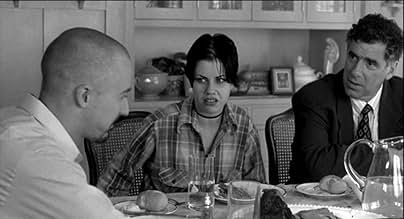
What matters most here isn’t the content — it’s the delivery. Derek is calm, informed, and controlled. He sits at the head of the table and speaks at length in complete arguments. He knows when to pause. He knows how to hold the floor. You can see how, with this charisma and call to action, he was able to rally so many disillusioned, loyal followers.
For Danny, watching his older brother in action, this is a masterclass in how ideology is made persuasive at home, long before it ever reaches the streets.
And again, it’s an older woman at the table, Derek’s mother Doris, clearly feeling uncomfortable, who attempts to diffuse the situation:
‘‘Who would like some dessert?’’
This line is delivered in a strained, hopeful tone — classic 'domestic peacemaking' to try pulling everyone back to normalcy and lighten the mood.
Much like Aunt Emma in Whiplash, Doris's instinct is not to challenge the content of what is being said, but to protect the ritual of a family meal.
In both films, this well-meaning move has the same effect: the speaker’s words land without consequence, while the discomfort is absorbed by those with the least power at the table.
The dinner scene in American History X operates at the opposite volume — but with equally devastating results.
Here, the table becomes a stage for ideological performance. Derek dominates the conversation with confidence and rhetorical skill, deploying racism not as rage but as logic.
What’s especially chilling is not just what he says, but how it’s received by a teenage Danny, who holds his brother on a pedestal.
From a neurodivergent angle, this scene illustrates how certainty can be seductive. Clear rules. Clear enemies. A worldview that explains pain — in this context, the traumatic death of their father — and offers belonging.
For Danny, watching closely, this is a lesson:
This is how you sound powerful
This is how you win an argument
This is how you belong.
Neurodivergent people — particularly those who crave structure, clarity, or moral coherence — can be vulnerable to rigid ideologies. Not because of weakness or lack of intelligent, independent thought, but because uncertainty is exhausting.
The dinner table becomes the site where belief is transmitted. Not through force, but through fluency.
Weapons at the table
Despite their differences, these two scenes are mirrors. One shows what happens when intensity is dismissed, the other when it’s rewarded without challenge.
Both show a young person trying to define themselves, a family system that cannot hold complexity, and a moment where silence or speech shapes a future.
One weaponises dismissal. The other weaponises persuasion.
In both cases, the damage happens in plain sight.
No-one flips a table or storms out. Life just goes on.
And that’s the point.
These scenes linger because they mirror how harm often functions for neurodivergent people — not through one catastrophic event, but through repeated, socially acceptable slights. Individually minor, they accumulate over time, wearing down self-esteem until daily life feels like walking on thin ice, where stability is assumed but never guaranteed.

Uncomfortably familiar
Society often talks about radicalisation, burnout, or obsession as if they emerge in isolation.
Films like Whiplash and American History X remind us that identity is forged relationally. In innocent-looking rooms where people try to explain themselves. In spaces that reward certain kinds of expression and punish others.
For neurodivergent viewers, these dinner tables feel uncomfortably familiar. They echo the moments where you realised that your values don’t translate, your intensity makes others uneasy, and your way of being requires justification in a way that is simply not asked of others who better fit social norms.
And sometimes, they explain why being misunderstood can hurt more than being opposed.
A dinner table doesn’t need sharpened steak knives to be dangerous.
All it takes is an audience, a hierarchy of values, and a refusal — or inability — to truly listen.
That’s how you weaponise a dinner table.


Comments